
The other day, I listened to college students discussing “Medicare For All.” They were supporting Democratic Socialists of America candidate Alexandria Ocasio-Cortez and Senator Bernie Sanders, both of whom are currently touting this idea. In addition to Medicare, the students are apparently upset that someone is going to take away their plastic bendy straws. But let’s stick to Medicare.
When asked how we would pay for this, Ocasio-Cortez and Sanders have been unclear, if not elusive. A recently-released study by the Mercatus Center at George Mason University showed that the plan would require historic tax increases. That analysis estimates the plan would cost, conservatively, between $24.7 trillion dollars and $34.7 trillion dollars over ten years. No one seems to know what the following ten years would cost. My guess, based on the fact that population will increase, is that I shouldn’t count on the price going down.
The students were very clear about how to pay for it. “From the government,” or “from the rich,” each of them said. But when asked what would happen if the government or these rich people ran out of money, they said “taxes.” Maybe they didn’t realize that the government’s money is taxes. Maybe they didn’t realize that taxes include rich peoples’ money. They seem to believe that every wealthy individual in our country got that way by doing something evil and should, therefore, give it back.
Before my liberal friends assail me (and they will), maybe we should back up and think about what is at issue here. It’s not a moral issue; it’s a mathematical one. It’s not about bad people not wanting to help good people. It’s about whether we can do it. We can talk about Medicare For All until we’re blue in the face, but sooner or later, somebody has to figure out how to do it. Part of the process of helping people in a substantial and sustainable way is finding out if we can afford affordable care and if we’ll be able to continue helping. The old Boy Scout first rule for lifesaving: Save Yourself First. You can translate that as “If you drown, you’re of no help to anyone.” Sooner or later, someone has to pay the Piper, and I have a sinking feeling that you and I are not the said Piper.
Supporters of Medicare For All say, and the Mercatus study states, that the plan could reap substantial savings from lower prescription costs–$846 billion over ten years, because the government will be dealing directly with drug manufacturers. Mind you, that is the same government that gave the University of New Hampshire $700,000 to study methane gas emissions from dairy cows, and spent thousands of dollars for a hammer or a box of Kleenex. Maybe they should let us make those deals at Wal-Mart, because I can get Kleenex for eighty-nine cents. Cutting your $30 trillion dollar bill by $846 billion is like spitting on the Hindenberg as we go down in flames.
It’s my understanding that many universities are no longer requiring courses in government and history. That could be part of the problem. George Santanyana once said “Those who cannot remember the past are condemned to repeat it.” Socialism has always failed, because the Piper had to be paid, eventually. In the Russia of 1917, the people revolted against what they believed to be tyranny. Along came Vladimir Lenin shouting “Revolt in the name of the proletariat,” beginning what would be the most oppressive regime in world history. And, we might add, a country bankrupt and unable to help anyone.
I want to help good people, but I know I have to be able to help. Don’t trust our salvation to the government. Trust it to folks who can find a bargain on Kleenex. The government knows virtually nothing about anything. Other than taking things it hasn’t earned.
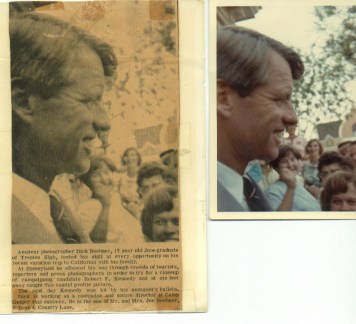 I was sort of “ok” with the shot. It’s slightly out of focus (remember I was shooting blind and in those days, only young peoples’ eyes had auto-focus.) From a photographer’s eye, there’s a lot wrong with it. And every photographer worth his salt wants to be remembered for the shots that he actually planned and intended to take. That’s when they call you an artist. They don’t do that when your jaw has dropped and you fumble to push a button. But it’s mine and it’s real.
 ur local newspaper, the Republican-Times. And there, on the next day and on the front page, was my color photograph in living black and white. It says I elbowed my way through the crowd. Not true. My mom probably imagined that. It says I was six feet away. I was a lot closer than six feet. Either my mom made that up too, or the news media hasn’t changed much in fifty years.
 their letter, I consider getting in the car and driving to Gibsland. I always decide against it. Maybe one day I’ll go, but it won’t be on The Authentic Festival day. I’d like to stand by myself on that highway southwest of town and imagine. I’ve read the books. I know what happened. I think my imagination would be more interesting than seeing people standing around with their t-shirts and koozies. Maybe one day I’ll go. Maybe one day I’ll buy a magnet.
 commonsense